

How to Lose Friends and Resurrect People: My Book Report on Alchemised

Apparently, Alchemised is the hottest book on BookTok right now.
Everyone’s thirsting over the necromancer and making Pinterest boards of their trauma.
I tried to resist. I really did.
But then the algorithm got horny for me and wouldn’t stop shoving it in my face.
So fine… I surrendered.
And that’s how I ended up writing a book report about late-stage capitalism and vivimantic sterilization.
I didn’t buy Alchemised so much as it abducted me.
For weeks it followed me through the algorithm… ads, sidebars, polite recommendations that felt more like summonses.
I don’t read fantasy. I’ve never endured a wizard franchise craze, book nor movie. But this book would not stop appearing until I finally said, Fine. I’ll read your little necromantic manifesto.
And then the trap snapped shut.
Somewhere between the undead armies and the alchemical warfare, I realized I wasn’t reading fiction. I was reading documentation; classified minutes from the Department of Transformation, where every “life-art” I’d ever studied in the personal development space had been given its true name.
Vivimancy. Animancy. Necromancy. Pyromancy.
Suddenly the vision board on my wall looked less like a self-help project and more like a resurrection altar.
Below is my interpretation of Alchemised… though “interpretation” feels generous.
It’s closer to remembrance; a report from a timeline that shouldn’t exist but somehow does.
Call it satire if it helps you sleep.
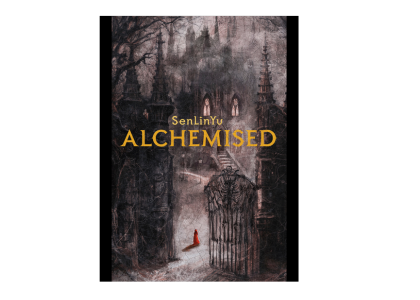
The Life-Arts Were Just Self-Help in Robes
In Helena Marino’s (our female protagonist) world, every power has a name:
Vivimancy heals and births.
Animancy binds soul to soul.
Necromancy manipulates what refuses to die.
Pyromancy purges through fire.
In ours, we just market them.
Vivimancy became “manifestation coaching.”
Animancy rebranded as “spiritual work.”
Necromancy turned into “inner-child or shadow work.”
Pyromancy? That’s the continuous-healing loop; our spa-like retreat version of self-immolation.
We keep lighting the same wound just to prove we’re still “doing the work.”
We call it transformation, but it’s really the nervous system’s version of a controlled burn gone rogue.
The ritual of never being “there yet” is how we keep ourselves safe from actually arriving, similar to how the Undying in Alchemised keep resurrecting themselves.
Pyromancy was once the sacred fire that refined the alchemists’ iron into gold.
Now it’s the burnout bonfire we gather around for community, each of us tossing in another version of ourselves for warmth.
We’ve turned what was meant to be a moment of passage into a permanent residency… shadow work as spa day, integration as identity.
Same crafts, different fonts.
Helena and her mentors mixed elixirs; we mix affirmations. Both claim to transmute lead into gold. The only difference is that she risked damnation, and we risk bad Reddit reviews.
Still, the principle holds: focus long enough, believe hard enough, and matter rearranges itself.
If that isn’t vivimancy, what is?
We just replaced bone fragments with Canva templates and called it mindset.
The Dullium Cuffs and the Five-Step Plan
Just like in any empire worth its branding, power must be domesticated.
Every age invents a new anesthetic. The ingredients change, the intention never does.
The alchemists forged Nullium Cuffs: rings of lithium & Mo’lan’shi-laced alchemy that silenced resonance until the body forgot it had power.
We forged our own version.
We call it Dullium.
Dullium isn’t mined; it’s marketed.
It comes packaged as morning routines, productivity hacks, and high-vibe sound baths that promise “clarity.”
It doesn’t burn; it dulls.
(Imagine being my chym partner. Half the lab notes are metaphors about burnout; the other half are confessions about wanting to set the system on fire.)
It smooths the edges of desire until all you can feel is the hum of incremental progress.
The transformation industry doses us daily.
Step 1: identify your limiting beliefs.
Step 2: reframe them into gratitude.
Step 3: visualize abundance.
Step 4: stay positive.
Step 5: repeat until numb.
Helena’s cuffs blocked resonance.
Our Dullium dampens eros: the primal current that gives power texture, scent, hunger.
It replaces pulse with performance, ache with affirmation.
You don’t lose sensation all at once; you drift.
The body enters a trance of achievement, eyes open, soul sedated.
Containment disguised as calm.
We call it alignment.
It’s really just the alchemical era of self-suppression… a culture so obsessed with progress it mistook anesthesia for evolution.
The Prison of Enlightenment
In Alchemised, the necromancer prisons didn’t waste guards on its prisoners.
They engineered psychology.
They taught the wardens to pit the inmates against each other, to channel their rage laterally instead of upward.
When anger wanted a target, it always found another prisoner, never the source of the spell.
It was the most efficient control system ever invented: obedience by rivalry.
We inherited that model and renamed it spiritual hierarchy.
The transformation industry learned that if you convince people that “low vibration” is contagious, they’ll quarantine themselves.
Corporate culture learned that if you equate busyness with virtue, employees will compete to out-sacrifice one another.
Network marketing learned that if you insult the very people you’re recruiting, they’ll still thank you for the humiliation.
Hell, you tell them that J.O.B. means “Just Over Broke,” mock their security, then ask them to trust you with their future; an initiation by negging.
And the self-help elite learned that if you promise salvation through optimization, no one will notice they’re still serving the same gods… just wearing yoga pants instead of uniforms.
Dullium makes the bars invisible.
It replaces rebellion with self-correction.
The spiritual attacks the non-spiritual, the coach dismisses the corporate, the entrepreneur mocks the employee.
Each camp claims moral altitude, never realizing they’re all humming the same frequency of control.
Morrough’s (our antagonist) prisoners tore each other apart so the guards could rest.
We scroll, compare, and clap for each other’s “alignment” so the algorithms can feed in peace.
Our cages are ergonomic, aesthetically pleasing, and [thanks to Dullium] almost euphoric.
Helena’s captors drained vitality to keep order.
We drain eros through righteousness.
And the quieter we become, the more the wardens can sleep.
The Kaine Ferron Hypothesis
Every system invents its own heretic.
In Alchemised, that role belonged to Kaine Ferron; traitor, necromancer, lover, the man tethered to evil who dared to remember what life felt like.
While Paladia preached purity and Morrough perfected control, Kaine whispered the one thing no order can survive:
What if they’re both lying?
He was the static in the signal, the bad frequency Nullium couldn’t quite mute.
Helena was supposed to fear him, maybe even kill him.
Instead, she listened… and then she crossed the line they told her would damn her.
She didn’t just hear him; she touched him.
She seduced the heretic she was sent to destroy, and in doing so, she fucked the system that had sterilized her.
The irony, of course, is that the so-called villain was the messenger.
The one she was warned against was the only one telling her the truth.
And isn’t that always how it goes? We discard the message because we don’t like the messenger.
If truth doesn’t arrive wearing the right costume—priest, guru, influencer, certified coach—we dismiss it as danger instead of deliverance.
The same way we dismiss erotic fiction, fantasy novels, or even books like Alchemised themselves—because they don’t look like the sanctioned path to sovereignty.
We tell ourselves that truth can’t possibly live in arousal, or satire, or imagination.
But that’s the sleight of hand.
The truth has always been too indecent for polite mediums.
And polite mediums are the only place we’re looking.
(Which means if you’ve made it this far into an erotic-metaphysical book report, congratulations… you’re already fraternizing with the enemy.)
That’s the real bad-boy fantasy: not rebellion for pleasure’s sake, but rebellion as resurrection.
A woman abandoning the boundaries built to keep her good, choosing aliveness over obedience.
Every empowerment manual warns you not to lose yourself in the dark.
But Helena’s awakening begins when she does exactly that,
because sometimes the only way to find the truth is to surrender to what you were trained to fear.
That’s what every modern Kaine does: he disturbs the trance.
He’s the colleague who asks why your “alignment” always looks like avoidance.
The friend who says your endless gratitude sounds a lot like repression.
The creator who posts the thing everyone privately thinks but won’t touch because it might cost followers, clients, or calm.
We call them cynical, unhealed, shadow-ridden.
But they are simply the ones who remember sensation.
Their presence re-magnetizes the room, reminds us that power has temperature, that truth isn’t polite.
In Morrough’s prison, one whisper of rebellion could set the array vibrating—energy ricocheting until the guards lost control.
That’s what Kaine does to Helena: he reintroduces friction.
And friction is what every empire of harmony fears most.
When someone like Kaine appears in your world [unfiltered, inconvenient, unwilling to chant the affirmations] notice your first impulse.
If you reach for Dullium, you’re protecting the trance.
If you lean in, even as your heart pounds, you’ve begun to wake.
The Sanitized Womb of Self-Help
Vivimancers could heal, mend, and make life from ruin, but the state decided they couldn’t hold that power and allegiance.
You could serve Paladia or any other regime, for that matter, or you could serve life, but never both.
So every vivimancer who pledged was sterilized; man or woman.
No wombs, no seed, no duality.
Because duality is dangerous.
It blurs lines that hierarchies depend on.
It makes obedience ambiguous.
And ambiguity is how freedom sneaks in.
Helena’s sterilization was not cruelty: it was containment disguised as clarity.
The Order feared a healer who could also be a mother; a creator who could also destroy; a being who could hold both the light and the soil that births it.
So they severed creation from loyalty and called it devotion.
We’ve done the same.
Modern self-help sterilizes us with language that forbids contradiction.
You can be spiritual or sexual, grounded or ambitious, soft or strong, but not both at once.
We chant balance, but what we really worship is purity; a life scrubbed of paradox.
We amputate the ache that makes us whole, then call the numbness peace.
Helena accepted the operation because she believed she couldn’t serve two masters: Paladia and the pulse of her own body. (though she wasn’t really given the option - it was stated as absolute by tugging on her shadow of saviorism.)
Isn’t that what we’re told too?
That desire and discipline are incompatible, that devotion demands disowning want?
We fear holding both the hunger and the obstacle to it, forgetting that this tension [the friction between creation and limitation] is what generates life in the first place.
Like most of us, Helena was solving for the wrong problem.
She mistook worth for signs of animation, believing her salvation lay in service, not sensation.
Her saviorism became a spiritual performance review, every act of healing another attempt to prove she deserved to exist.
But magic, like creativity, was never meant to prove worth. It is worth. It’s the pulse itself; the evidence of being alive.
We do the same thing now, just with better branding.
We chase job titles, follower counts, and revenue thresholds as if they’re sacraments; proof that we’re evolving, succeeding, ascending.
But what we’re really searching for is proof of life: that something still moves in us, that the current hasn’t gone flat.
Every time we launch an offer, post a thought, or whisper a desire into the void, we’re not asking for validation… we’re begging to be resurrected.
We’re asking for an influx of life-force energy strong enough to wake us from the trance.
And the cruel genius of it is that we don’t even need wardens anymore.
The prison has been internalized.
Just as Morrough’s guards taught the inmates to turn on one another, we’ve learned to turn on ourselves.
We call it discipline, ambition, integrity, but it’s self-policing disguised as self-improvement.
The moment our magic flickers alive, we rush to manage it.
We critique it, monetize it, perfect it… anything but feel it.
Because feeling would mean admitting that evidence of pulse has been here all along, waiting to burn through our curated worth.
And this was Kaine’s heresy all along.
He kept trying to show Helena that she wasn’t serving Paladia by choice: she’d just been conditioned so deeply that obedience felt like autonomy.
She believed her sacrifice made her holy, when really it made her useful.
Every act of service, every ounce of restraint, every moment of self-denial was feeding the very system that stole her power.
That’s what happens when the cage becomes familiar enough to call home.
The guards don’t have to keep you anymore; you keep yourself.
When Helena’s fertility was later restored, it wasn’t mercy.
It was manipulation.
Her body was re-opened only to bear a child the Undying could exploit, proof that even restoration can be weaponized when duality is forbidden.
Our culture does the same sleight of hand:
re-activating our creativity just enough to feed the machine,
re-branding sterilization as empowerment,
selling the illusion of choice while keeping us too divided to birth anything truly our own.
But real alchemy requires holding both: the desire and the danger of it.
To create, we must risk contradiction.
To live, we must consent to be torn.
Helena’s true rebellion wasn’t escape: it was reunion.
When she finally chose both devotion and desire, both love and loyalty, both death and life, the spell broke.
Duality returned.
And with it, everything the worlds feared most: a woman who could hold her own paradox and call it power.
The risk of creation.
The willingness to feel the ache that proves you’re still alive.
Because once you’ve known what living tastes like,
no amount of peace will ever be enough.
The Fictional Prophets
Alchemised might be fiction, but sometimes fiction is how another timeline breaks through to warn us.
Every few decades, a story slips the veil… a glitch meant for the ones who already sense that something is off.
If Helena’s sterilization was personal, ours is cultural.
Her body was bound; our imagination was.
We’ve been trained to fear imagination the way Paladia feared necromancy; too taboo, too volatile, too unregulated, too prone to birthing gods that don’t ask permission.
That’s why the world treats fiction like playtime.
It’s the safest place to hide truth.
Because if you label something made up, no one will burn it.
They’ll just binge it.
But fiction keeps talking.
Sometimes through yellow-skinned oracles on The Simpsons.
Sometimes through starships and warp drives.
Sometimes through a necromancer who falls in love with his enemy and proves that death was just bad branding.
These are our cartoon prophets… broadcasting from a timeline that still remembers what we forgot:
that imagination is not invention. It’s remembering sideways.
The Mandela Effect is just a glitch in our collective anesthesia: proof that multiple realities have been trying to sync for decades,
that somewhere we already lived the story right, and our bodies are trying to remind us.
When The Simpsons “predicts” the future, it’s not foresight - it’s bleedthrough.
A trace of a world less sanitized by disbelief.
A signal from a timeline where imagination was still trusted to lead.
Our ancestors once called that prophecy.
Now we call it coincidence and go back to scrolling through our curated awakenings.
Helena’s world called it animancy; life speaking through soul.
We call it “content creation,” and wonder why the resonance is gone.
Because imagination still misbehaves.
And nowhere does it disobey more beautifully than in erotic fantasy.
Erotic fantasy is the body’s refusal to stay sterilized.
It is imagination’s last unregulated frontier; too wet, wild, and definitely too alive to be managed.
It remembers through sensation what the intellect has been trained to forget.
Desire bypasses ideology. It doesn’t care about enlightenment or optics; it just aches toward what’s true.
Erotic fantasy is animancy resurrected.
It’s how the life-force smuggles itself past the guards of morality, productivity, and ego.
It’s the original act of magic… the moment the imagined becomes felt.
And if felt deeply enough, it becomes real.
That’s why it’s shamed.
Because every time you let yourself want, you create something the system can’t monetize or moralize.
Want makes worlds.
And in an age of Dullium, that’s treason.
So the next time you find yourself aroused by something inexplicable, something that doesn’t fit your brand or your healing arc,
don’t rush to sanitize it.
You might be remembering sideways.
The Nullium Economy
Every age has its chosen anesthetic.
Ours just has better branding.
The Paladians and Undying called theirs Nullium: a metallic hush that severed resonance and made obedience feel like peace.
We call ours growth.
Professional growth. Spiritual growth. Personal growth.
Different names, same chemistry: a steady micro-dose of safety that keeps the world predictable.
Nullium was forged to stop bodies from vibrating past control.
We swallow Dullium to stop souls from doing the same.
One quiet capsule at a time [affirmations, metrics, dopamine hits, courses, coaching packages] we microdose ourselves into high-functioning compliance.
We call the sedation clarity.
We call the numbness stability.
We call the absence of longing mastery.
Helena’s cuffs silenced her magic.
Ours silence our eros.
We stay busy enough to avoid arousal, spiritual enough to avoid desire, enlightened enough to never have to feel.
That is the modern miracle: a society perfectly alive, and almost no one living.
But the cracks are showing.
You can hear them in the moan that escapes your throat when something finally turns you on, in body, in mind, or meaning.
You can feel them in the quiet rage that pulses under your curated calm.
You can taste them every time you say I’m fine and mean I’m dying a little slower today.
That’s not pathology.
That’s resurrection.
That’s your Kaine Ferron frequency breaking through the trance.
Every woman eventually arrives at this threshold: the moment she realizes she’s been serving the very order that numbed her.
The cuffs are still warm, but loose enough to slip off.
The air is sharp, raw, alive.
And here she stands… half-terrified, half-aroused, holding her own dose of Dullium and deciding whether to take it again.
Because there is no hero coming.
No guard to unlock the gate.
Only the remembering.
So this is your choice now:
to keep performing aliveness for the algorithm,
or to risk becoming living again.
The first will keep you safe.
The second will set the world on fire.
So maybe I’m just seeing patterns where none exist.
Maybe The Simpsons didn’t predict the future.
Maybe the Mandela Effect is just a collective typo.
And maybe this essay is nothing more than an overcaffeinated book report from a woman who can’t read a fantasy novel without dismantling the self-help industrial complex.
Or maybe not.
Maybe every glitch, every “coincidence,” every fictional prophecy is the same message repeating itself: alive is not the same as living.
You can keep dismissing it… keep dosing on Dullium, keep calling your numbness peace, keep confusing not unhappy for happy.
Or you can read the signs for what they are: an invitation to wake the fuck up.
Your move, animancer.
Some readers finish Alchemised swooning over the enemies-to-lovers arc.
I finished it with a full-blown thesis on the metaphysical sterilization of consciousness.
Apparently, my idea of a beach read is a 1000-page mirror for late-stage capitalism.
So if this sounds less like a book report and more like a fever dream—welcome to my mind. It’s romantic-war-story meets spiritual autopsy. Five stars. Would descend again.